Critical Minerals Are Now Part of India's Trade Strategy. Recovery Should Be Too
09 Sep, 2026By Karan Khurana1 min read
It's official: critical minerals are now firmly part of India's trade and investment strategy. In a written reply to the Lok Sabha, Commerce Minister Piyush Goyal confirmed that critical minerals are being prioritised in India's trade and investment engagements, including ongoing free trade agreement negotiations, linked to a broader push for supply-chain resilience across strategic sectors such as energy, electronics, semiconductors and pharmaceuticals.
That matters because it signals a broader shift in how India is beginning to view critical minerals, not simply as mining resources, but as strategic inputs for trade, manufacturing and long-term supply-chain resilience. Lithium, cobalt, nickel, graphite, rare earths and copper are increasingly becoming central to India's industrial future.
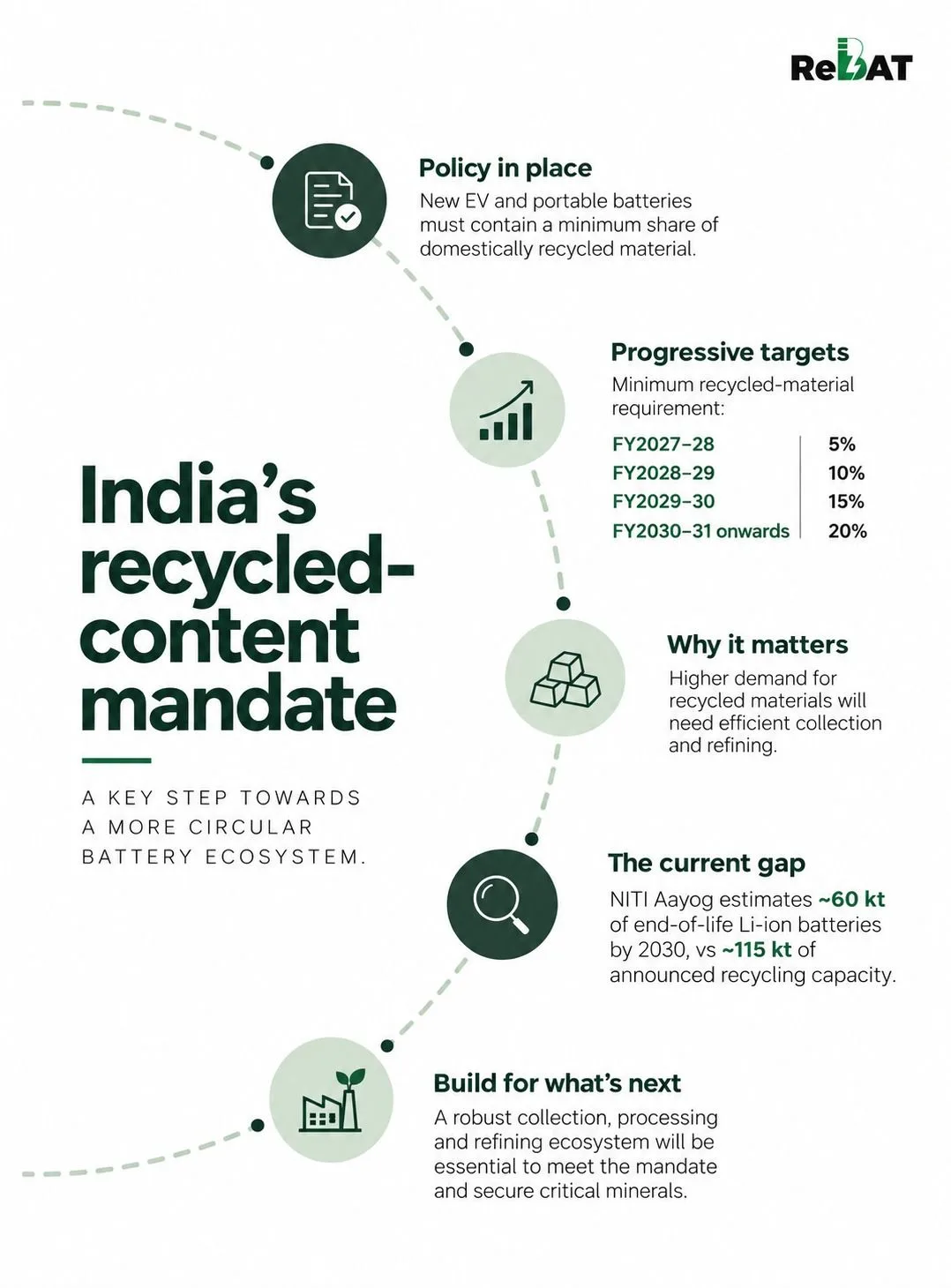
From the battery recycling industry's perspective, this raises an important question: if securing critical minerals is becoming a national priority, shouldn't recovering them be part of the same strategy? Trade agreements, overseas partnerships and diversified sourcing can help India secure future supply. But end-of-life batteries represent another opportunity: recovering valuable materials already within the country and bringing them back into the supply chain.
That is why battery recycling should be viewed as more than an environmental or waste-management activity. It is also about resource security. Critical-mineral security isn't only about securing new resources, it's also about making better use of the resources already in the system.