The Next Race in Recycling May Not Be for Capacity. It May Be for Feedstock
29 Sep, 2026By Karan Khurana1 min read
According to the IEA, global lithium-ion battery deployment has grown more than sixfold since 2020. For recyclers, that growth curve tells only half the story. EVs and stationary storage now account for around 90% of the lithium-ion battery market, but the batteries being deployed today will not become recycling feedstock tomorrow.
Deployment is growing much faster than end-of-life supply
The IEA estimates a roughly 15-year lag between the growth in EV battery demand and comparable volumes reaching end of life. Most batteries deployed during the recent boom are still in use and could remain there until the mid-2030s or longer.
Recycling capacity is already ahead of available feedstock
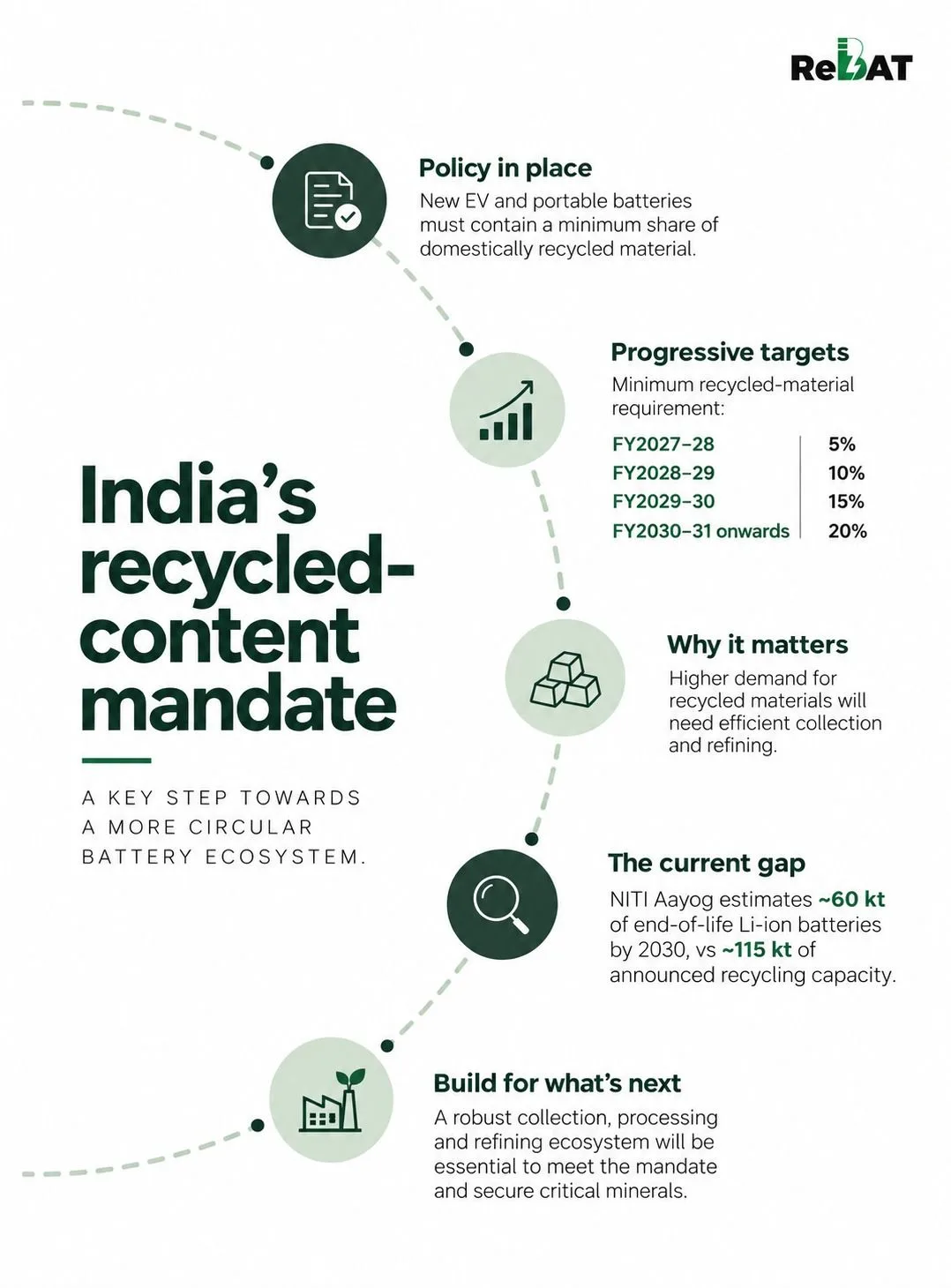
China hosts more than 85% of global battery material-recovery capacity, yet even globally, the IEA notes that recycling capacity currently exceeds available feedstock. India is seeing the same mismatch: NITI Aayog estimates that in 2025, only around 15 kt of end-of-life lithium-ion battery supply is available for recycling, against more than 80 kt of announced processing capacity. By 2030, available supply is projected at around 60 kt, while announced processing capacity could reach 115 kt.
That changes where the real bottleneck sits
Building recycling plants is one part of the equation. Getting enough end-of-life batteries into formal, traceable collection channels, and moving that material efficiently to recyclers, may become just as important as adding processing capacity.
The bigger takeaway from the battery deployment boom: the next race in recycling may not be for capacity. It may be for feedstock.