India's Battery Opportunity Doesn't End at Recycling
16 Sep, 2026By Karan Khurana1 min read
India's battery opportunity doesn't end at recycling. When we see an end-of-life battery, the immediate question is often: how do we recycle it? A different question should come first: what is the highest-value next use for this battery?
An end-of-life battery may still have value. Depending on its condition, it could be repaired, refurbished or repurposed before it ever reaches a recycling plant, and that starts with testing: understanding the battery's condition and determining whether it can be safely reused, repurposed, or needs to be recycled.
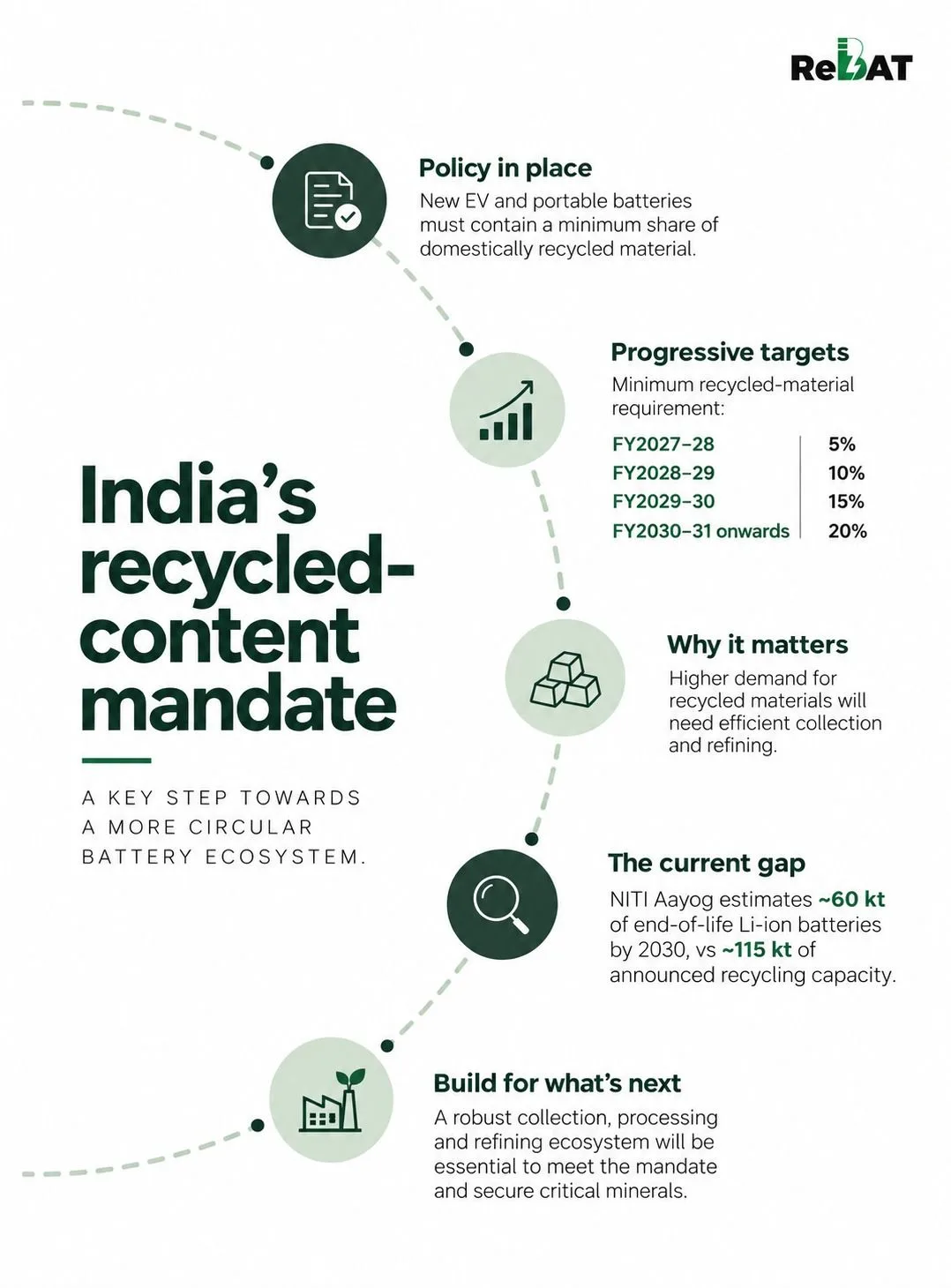
The scale makes this even more important. NITI Aayog projects India's end-of-life lithium-ion battery availability for recycling to grow from 19 kt in 2023 to 233 kt by 2035. But simply building more recycling capacity won't be enough. We need to build the value chain around the battery: collection, testing, reuse or repurposing, recycling, black mass, and critical mineral recovery. The objective should be simple: extract the maximum value from a battery at every stage of its life.
India's battery opportunity isn't just about building bigger recycling plants. It is about building an integrated battery value chain, from collection and testing to second-life applications and, ultimately, critical mineral recovery. The question is not just how much can we recycle, it is what is the highest-value next use for this battery.