What is Battery Recycling & Why It Matters in 2026?
30 Nov, 2025By Admin3 min read
The world is accelerating toward sustainable energy and electric mobility, and at the heart of this transition lies a challenge most businesses are only beginning to reckon with: what happens to batteries when they die? For companies in the energy, automotive, electronics, and industrial sectors, battery recycling has shifted from a back-office compliance checkbox to a boardroom-level strategic priority.
What Is Battery Recycling, and Why Does It Matter Now?
Battery recycling involves the systematic collection, processing, and recovery of end-of-life, defective, or spent batteries to extract high-value materials such as lithium, cobalt, and nickel. Rather than allowing toxic chemicals to leach into soil and groundwater, these recovered materials are reintroduced into new battery production, closing the loop on a truly sustainable supply chain. The key stages are Collection & Reverse Logistics, Sorting & Dismantling, and Material Recovery (hydrometallurgical or pyrometallurgical processes recovering critical metals at maximum yield).
5 Reasons Battery Recycling Is a Business Imperative in 2026
- Battery waste is exploding: rapid EV adoption, renewable energy storage, and consumer electronics demand are generating enormous volumes of end-of-life battery waste, creating both environmental risk and a resource-recovery opportunity.
- Critical material security: lithium, cobalt, and nickel are mined predominantly in geopolitically volatile regions; recycling offers a stable, domestic source of these inputs.
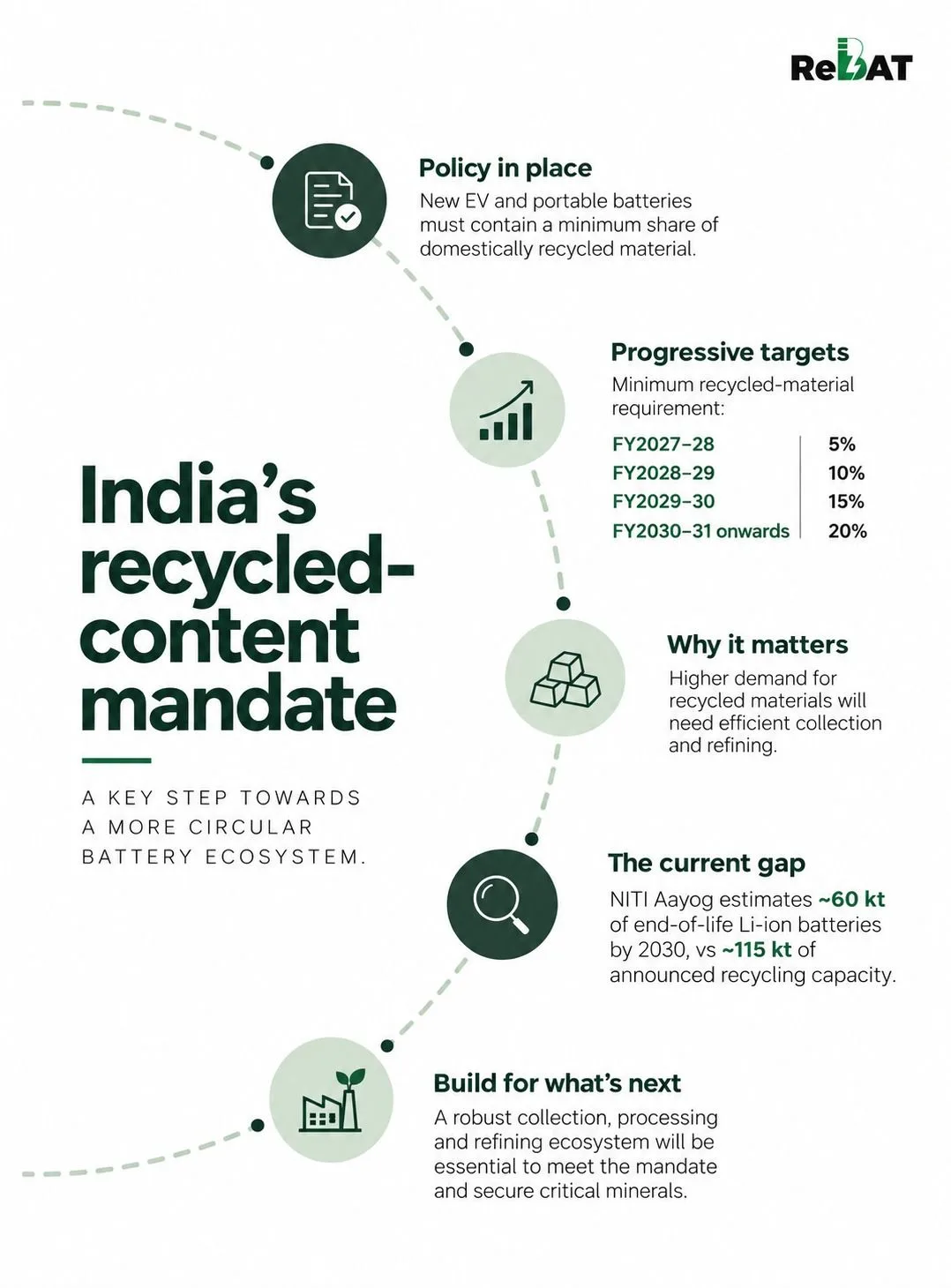
- Regulatory compliance is no longer optional: India's EPR framework for batteries is tightening fast, with growing legal, financial, and reputational consequences for improper disposal.
- The circular economy is a competitive advantage: recycling delivers cost savings, new revenue streams, and stronger ESG positioning that attracts capital and enterprise customers.
- Technology is making recycling more viable than ever: advances in hydrometallurgical and direct recycling are improving recovery rates and lowering per-unit processing costs.
The Honest Challenges
Battery recycling is not without complexity: diverse battery chemistries complicate sorting, reverse logistics costs rise across dispersed collection points, facilities are capital-intensive, and metal prices are volatile. These factors explain why India's battery recycling rate remains far below its potential, and why the choice of recycling partner matters enormously.
2026: The Inflection Point You Cannot Afford to Miss
- First-generation EV batteries are reaching end-of-life at scale.
- EPR mandates are becoming strictly enforced.
- Volatile critical mineral prices are increasing the strategic value of recycled feedstock.
- Recycling technology is crossing the threshold of clear commercial viability.
Your Action Plan: 5 Steps to Get Started
- Partner with a certified recycler for secure, compliant, and efficient recycling operations.
- Integrate EPR compliance into product lifecycle and procurement planning from day one.
- Adopt closed-loop procurement: actively source recycled battery-grade materials.
- Scale logistics and collection networks proactively, ahead of growing end-of-life volumes.
- Embed recycling into ESG reporting to enhance brand credibility and investor confidence.
What is battery recycling?
Battery recycling is the process of recovering valuable materials like lithium, cobalt, and nickel from used batteries for reuse in new products.
Why is battery recycling important?
It reduces environmental pollution, conserves natural resources, and supports a sustainable circular economy.
What is EPR compliance for batteries?
EPR (Extended Producer Responsibility) requires manufacturers and importers to ensure the proper collection and recycling of used batteries.
How does battery recycling benefit businesses?
It helps businesses meet regulations, reduce raw material dependency, improve ESG performance, and strengthen supply chains.
Conclusion
In 2026, battery recycling is simultaneously an environmental necessity, a regulatory requirement, and a genuine business opportunity. For B2B companies across energy, mobility, electronics, and industrial sectors, one truth is undeniable: partnering with a trusted recycler isn't just good for the planet, it's smart, future-proof business.